In the house
Is lab-grown meat halal?
Updated 28 September 2026
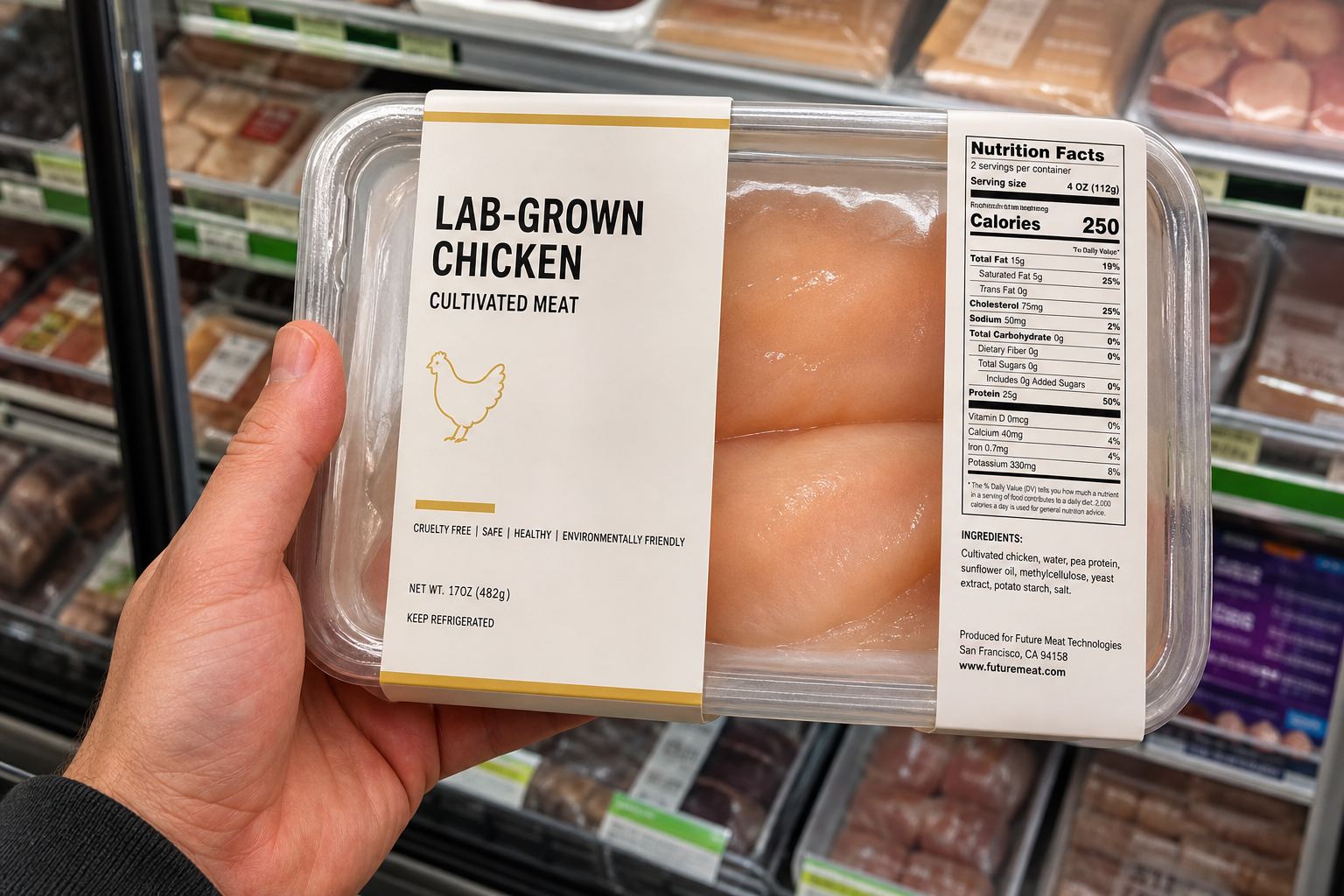
Whether cultivated meat is halal remains one of the more unsettled questions in contemporary Islamic scholarship, because it breaks an assumption every earlier ruling on meat relied on. Zabiha slaughter governs how an animal is killed, and cultivated meat, also called lab-grown or cell-based meat, is grown from animal cells in a bioreactor without killing anything at all. Scholars are still working out whether a rule built around the method of killing an animal has anything to attach to when killing isn't part of the process.
What cultivated meat actually is
The basic idea is simple even though the biology isn't. A small sample of muscle cells is taken from a donor animal, usually without harming it, and placed in a bioreactor along with a nutrient-rich growth medium and often a scaffold that helps the cells organize into something resembling muscle and fat tissue. Over days or weeks, the cells multiply and mature, and the resulting tissue is harvested, processed, and shaped into a final product. The donor animal can, in principle, keep living long after its cells were collected.
That's the detail that makes this different from anything classical fiqh had to address before. Every prior ruling on meat assumed an animal was killed at some point in the chain between farm and plate. Cultivated meat breaks that assumption at the root.
The question sitting at the center of it
Zabiha slaughter is specific: a defined method of cutting the animal's throat vessels while it's alive, performed by a qualified person invoking Allah's name. It's a ruling about how you kill something. So the question scholars are actually working through isn't "is this meat good or bad," it's more basic than that: does a rule about the method of killing an animal apply to a product where no animal is killed during production at all?
Some scholars frame cultivated meat as still being animal flesh, however it was multiplied, and treat it as subject to the same slaughter requirement as conventional meat. Others frame it as a new category entirely, closer in structure to how fiqh already treats other animal-derived ingredients, judged by source species and processing inputs rather than by an act of killing that never happens. Both are reasoned positions, not casual guesses, and neither has become the dominant view.
Two developing views, and why neither has won out
Here's roughly where the current thinking splits, stated as fairly as it can be without pretending either side has settled the matter.
| View | Core reasoning | What it would require |
|---|---|---|
| A slaughter step is still required | The product is still animal flesh regardless of how the tissue multiplied, so removing the killing step removes something obligatory rather than something irrelevant. | The donor animal would need to be a halal species and be slaughtered according to zabiha, whether at cell collection or some equivalent point. |
| No slaughter requirement applies | Zabiha is a ruling about the method of killing an animal, and no animal is killed in the culturing process, so the ruling has nothing to attach to. | Focus shifts to the donor species and the inputs used, such as the growth medium and scaffold material, similar to how gelatin or enzymes are already evaluated. |
Singapore's Fatwa Committee is one body that has published a position. In guidance announced by MUIS on 3 February 2024, it said cultivated meat is generally halal if three conditions are met: the cells come from an animal that is halal to eat, every ingredient that makes up the product is halal, and the product is non-toxic and clean. Those conditions say nothing about slaughter, which puts that guidance closer to the second view in the table. It is one committee's guidance for Singapore, not a global consensus, and other bodies may set different conditions. The absence of one agreed answer reflects how new the technology is and how carefully scholars tend to move before issuing something meant to apply broadly. Expect this to keep developing rather than resolve quickly.
What to actually check on a product
Until there's more convergence, the honest answer to "is it halal" is "it depends who you ask and what's actually in the specific product." A few things matter more than the headline question. Who certified it, and under which standard? What was the donor species? What went into the growth medium, since some formulations have historically used animal-derived components like fetal bovine serum, and what the scaffold is made from. Those are the same categories of question you'd ask about any processed food, which is exactly what a halal ingredient checker is built to help sort through when a label lists things you don't recognize.
This isn't the first time a production method has mattered more than a simple source question. The same logic shows up with creatine, where the compound itself is generally synthesized rather than animal-derived, and the real question ends up being the capsule material and flavoring rather than the creatine itself. Cultivated meat asks a bigger version of that same question.
It's also a reminder that Islamic scholarship has always had to take classical principles and apply them to things that didn't exist when those principles were written down. The same pattern shows up in how zakat is calculated on assets that are only decades old at most, like the crypto holdings people now run through a zakat calculator at today's market value rather than what they paid. New categories of wealth or new categories of food both end up tested against old frameworks, and sometimes that testing takes years to settle.
What makes this debate different from most other ingredient questions is that the disagreement isn't about facts. Everyone working on this agrees on how cultivated meat is produced and that no animal dies during that production. What's unresolved is a question of methodology: whether a ruling written for one situation, the killing of an animal, extends to a product built around not killing one at all. No certification mark or ingredient list can settle that by itself, and it may be years before scholars reach anything close to a shared answer. For now, the honest position is that this particular question stays open.
Quick answers
- Is it vegetarian?
- Not automatically. Starter cells are usually animal. The medium may include animal components.
- Can a certification body mark it?
- Some are studying it. A mark, if it appears, is that body’s view, not a global consensus.
- Is insect protein the same debate?
- No. Different source, different classical texts. Separate page.
General information, not a fatwa. Where scholars differ, we try to say so. For your situation, ask a scholar you trust.