In the house
Is alcohol in food flavouring halal?
Updated 6 September 2026
There is no single answer: some scholars accept small, non-intoxicating amounts of alcohol in food flavoring, and others don't accept any amount at all, regardless of how little is left in the finished product.
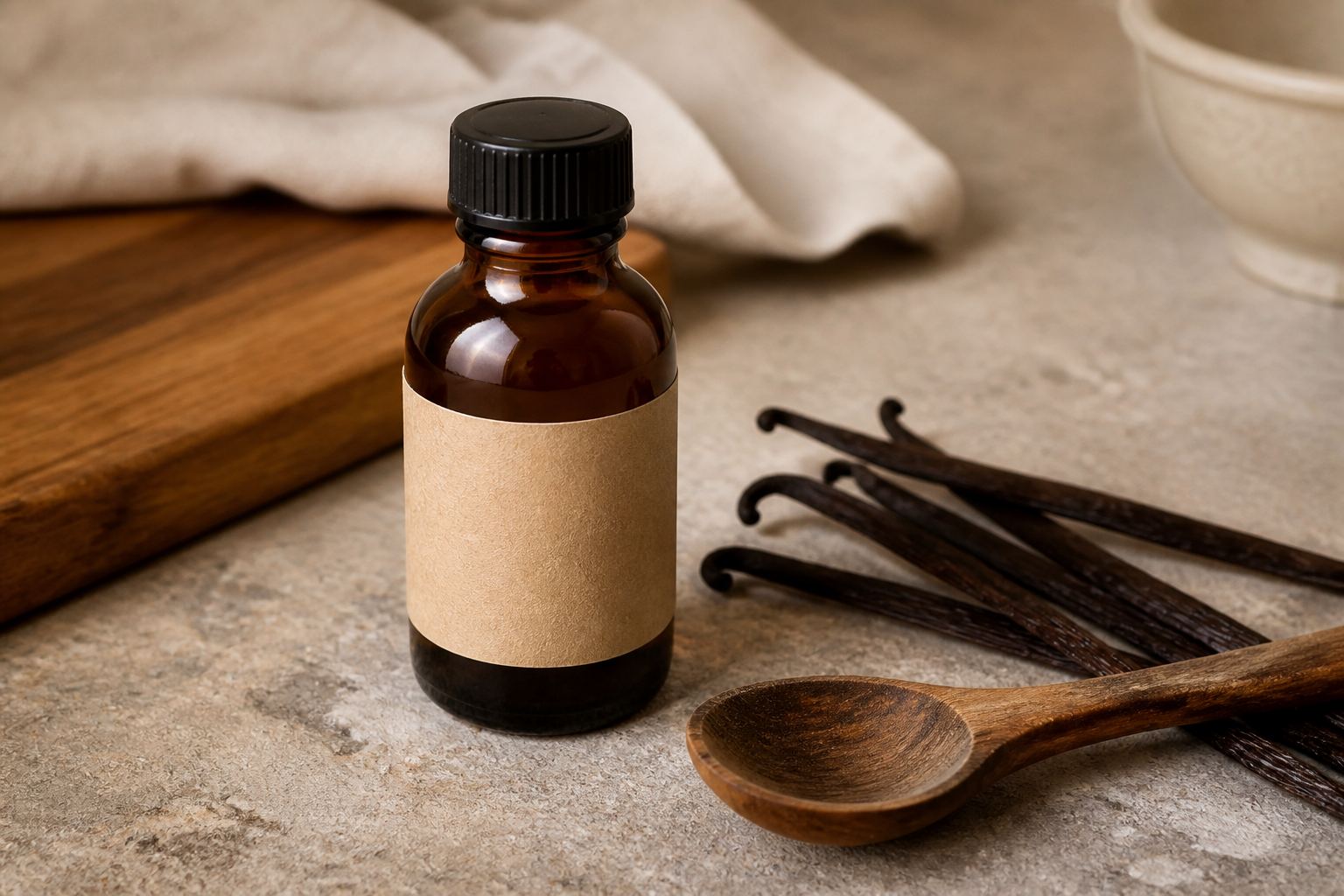
Vanilla extract is the example that comes up most, because it's genuinely everywhere, in cakes, cookies, ice cream, and countless packaged goods. Real vanilla extract is made by soaking vanilla beans in ethanol, which pulls out the flavor compounds. By the time a recipe calls for a teaspoon of it, the alcohol content of the final dish is usually tiny, often near zero after baking, but the extract itself is typically around 35 percent alcohol by volume before it's used. That gap between "the bottle" and "the finished slice of cake" is exactly where the two scholarly positions diverge.
the permissive view
Some scholars hold that trace, non-intoxicating alcohol used as a processing aid or flavor carrier does not make food haram, particularly when the alcohol evaporates during cooking or is present in amounts far too small to intoxicate. Part of the reasoning here draws on the concept of istihalah, the idea that a substance's ruling can change when its nature is fundamentally transformed, so an ingredient that started as grape or grain alcohol but has become chemically altered or diluted to negligible levels is treated differently from alcohol consumed as a drink. Under this view, a cake made with a splash of vanilla extract is not comparable to pouring a glass of wine, and the practical effect on the eater, intoxication or the lack of it, matters as much as the ingredient's origin.
the zero-tolerance view
Other scholars take a stricter line: any amount of alcohol, however small, keeps an ingredient off the halal list, full stop. This view treats the presence of alcohol itself as the disqualifying factor, not the quantity or whether it evaporates, and it doesn't rely on istihalah to soften that. From this angle, vanilla extract made with ethanol is out, regardless of how little ends up in the final dish, and the safer path is to look for alcohol-free vanilla, vanilla bean paste, or extracts made with glycerin instead of ethanol, which several brands now produce specifically for this reason.
Neither position is a fringe opinion. Both rest on real scholarly reasoning, and sincere, well-informed Muslims sit on each side of this question, reaching different conclusions from the same starting facts rather than from carelessness on either end.
how certifiers handle it
This split shows up in how certification bodies operate too. Groups like IFANCA (Islamic Food and Nutrition Council of America), HMC (Halal Monitoring Committee, UK), JAKIM (Malaysia's Department of Islamic Development), and MUI (Majelis Ulama Indonesia, Indonesia's halal authority) each publish their own standards, and they don't all draw the alcohol line in exactly the same place. Some certifications set a specific residual alcohol threshold a product must stay under; others require it to be entirely alcohol-free from any source. A "certified halal" label is a genuinely useful signal, but it's worth knowing which certifier issued it and, if you want certainty on this particular question, what that certifier's alcohol policy actually says.
| Question | Permissive view | Zero-tolerance view |
|---|---|---|
| Basis | Intoxication and effect matter; istihalah can apply to trace, transformed alcohol | Presence of alcohol itself is disqualifying, regardless of amount |
| Vanilla extract (ethanol-based) | Generally accepted in small culinary amounts, especially after baking | Not accepted; look for alcohol-free alternatives |
| Alcohol that fully evaporates in cooking | Often treated as a non-issue | Still avoided by some on principle, though views vary here too |
| Practical approach | Check that the amount is trace and non-intoxicating | Check the ingredient list for any alcohol at all |
If you're unsure which view to follow, it helps to ask what you'd do with genuinely uncertain cases elsewhere in your food choices. Some people default to caution across the board; others are comfortable relying on scholars who permit trace amounts, the same way they might weigh differing opinions on other everyday ingredients. Either approach is defensible. What matters is that you're making an informed choice rather than an assumed one, and that you're consistent about it rather than picking whichever answer is more convenient in the moment.
This kind of "check the actual substance, not just the category" thinking comes up elsewhere too. It's the same reasoning behind the question of whether creatine is halal, where the supplement itself is almost always fine and the real issue is what the capsule is made from and how it's flavored. If you're working through other practical obligations alongside questions like this one, the zakat calculator handles gold and silver nisab standards, including current crypto values, with the same idea in mind: get the specific number right rather than estimate it.
Quick answers
- Is vanilla extract the same issue?
- Yes, in a bottle you can see. See the vanilla page.
- Does “natural flavour” mean alcohol-free?
- No. It does not name the carrier.
- What about soy sauce?
- Fermentation alcohol is a cousin of this question. Separate page.
General information, not a fatwa. Where scholars differ, we try to say so. For your situation, ask a scholar you trust.