In the house
Is collagen halal or haram?
Updated 6 September 2026
Most scholars hold that bovine collagen is halal when it comes from an animal slaughtered according to zabiha rules and carries certification to prove it, though the concept of istihalah (transformation through processing) is a live point of discussion some scholars apply to heavily processed derivatives like this; marine collagen is generally halal without that requirement; porcine collagen is haram, no exceptions.
Collagen supplements and skincare products rarely spell out the source on the front of the label, which is exactly where the confusion starts. The word "collagen" by itself tells you almost nothing about whether a product is permissible. You have to look at where it came from: a cow, a fish, or a pig. Each has a different ruling, and two of the three depend heavily on details most brands don't bother printing.
the three sources, side by side
| Source | Typical status | What determines it |
|---|---|---|
| Bovine (cow) | Conditional | Halal only if the animal was slaughtered via zabiha and the product is certified; otherwise treat it as doubtful |
| Marine (fish) | Generally halal | Fish don't require zabiha style slaughter in the majority scholarly view, so sourcing is usually straightforward |
| Porcine (pig) | Haram | Pork is prohibited outright; no certification or processing changes that |
why bovine collagen depends on the slaughter
Bovine collagen is pulled from cow hides, bones, and connective tissue, all of which are permissible starting materials if the animal itself was slaughtered correctly. Most scholars hold that a cow raised and processed without zabiha slaughter doesn't become halal just because the collagen extracted from it goes through further processing afterward, since the animal's status at the point of slaughter is understood to carry through to whatever gets extracted from it later.
This is also one of the few spots in the collagen question where scholars hold real, ongoing differences of opinion. Collagen and gelatin come from the same protein family, and the concept of istihalah, transformation through chemical or physical processing that can change a substance's ruling, is a live discussion some scholars apply to heavily processed derivatives like bovine collagen. Others hold that no amount of processing changes what the source animal's slaughter status already settled. Because the question isn't fully closed, the more careful approach stays the same either way: treat uncertified bovine collagen as doubtful rather than assume it's permissible.
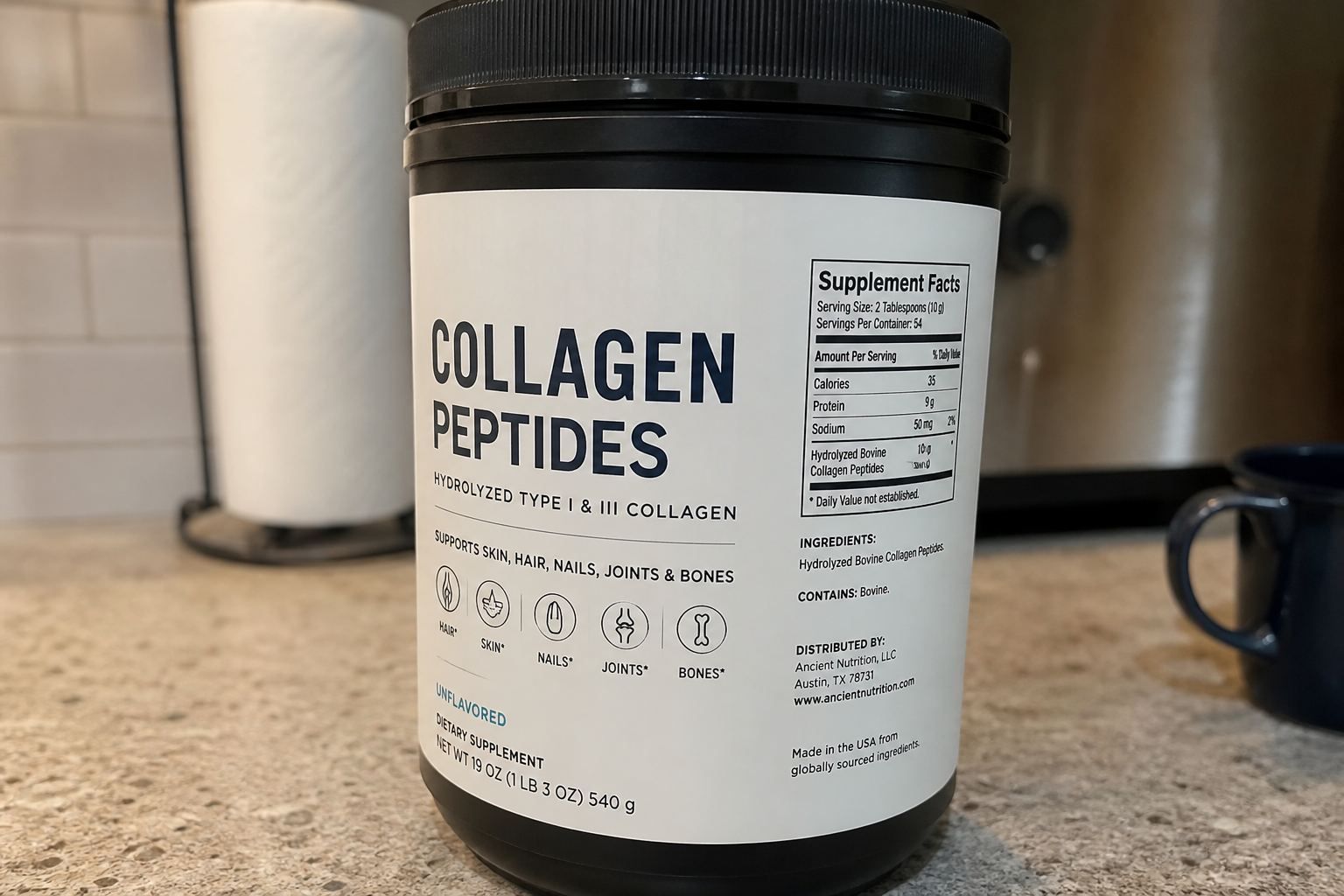
In practice, this means a jar of bovine collagen peptides sold in a general grocery or supplement store, with no halal mark and no detail on slaughter method, shouldn't be assumed halal by default. Look for certification from a recognized body such as IFANCA, HMC, JAKIM, or MUI. If none is listed and the manufacturer can't confirm sourcing on request, the more careful approach is to treat the product as unverified rather than permissible.
marine collagen: the simpler case
Marine collagen, drawn from fish skin and scales, is the more straightforward of the three. Fish don't carry the same slaughter requirement that land animals do, a point that also comes up with fish oil, so marine collagen is generally considered halal without needing a certification mark tied to slaughter method the way bovine collagen does.
That said, generally halal isn't the same as never worth a second look. Some marine collagen products are blended with other collagen types, or the capsule shell around the powder is made from a different source entirely. Reading past the front of the package to the actual ingredient list still matters, even in the easier case.
porcine collagen: no room for debate
Porcine collagen, sourced from pigskin, is haram. This one isn't a matter of scholarly disagreement or certification. Pork and its derivatives are prohibited outright, and no amount of processing, purification, or chemical transformation changes that status. The complication is practical, not religious: pig derived collagen shows up widely in cosmetics, gummies, and some supplements carrying generic labeling that never mentions the species at all. If a product just says "collagen" with no source named and no halal certification, porcine origin is one of the possibilities you can't rule out from the label alone.
what actually shows up on a label
Ingredient lists tend to use terms like "hydrolyzed collagen," "collagen peptides," or "gelatin" (a related but distinct processed form) without naming the animal behind them. That gap is where most of the real world difficulty sits, and it's the same gap that comes up with capsule shells generally, which is worth reading alongside our page on creatine, since the underlying question there is nearly identical: the core ingredient itself is fine, but the capsule material and any flavoring around it need their own check. When a collagen product's source isn't printed anywhere, running the specific ingredient through the halal ingredient checker is a faster path to an answer than guessing from the marketing copy.
If you're already using this site for other practical calculations, like the zakat calculator for working out annual giving, the same principle applies here too: check the specific source rather than leaning on assumptions, and don't treat an unlabeled product as automatically fine just because collagen, in its bovine or marine form, generally is.
Before you take another dose, pull up the label or online listing for your exact product and look for the words "bovine," "marine," or a certification mark. If none of those appear, contact the manufacturer directly and ask where the collagen came from before you decide anything else.
Quick answers
- Is collagen the same as gelatin?
- Same source family. Gelatin is processed collagen. The slaughter logic is the same.
- Does “grass-fed” mean zabiha?
- No. It is a farming claim, not a slaughter claim.
- What about vegan collagen?
- Those are usually amino-acid blends, not collagen. Read the ingredients; they have their own questions.
General information, not a fatwa. Where scholars differ, we try to say so. For your situation, ask a scholar you trust.