In the Pantry
Is Carrageenan (E407) Halal? What Muslims Should Check on the Label
Updated 6 October 2026
If you have ever flipped a chocolate milk carton and seen E407, you have met carrageenan, and the question most Muslim shoppers actually want answered sits underneath the E number, not on it.
What carrageenan actually is, and why the seaweed story is only half of it
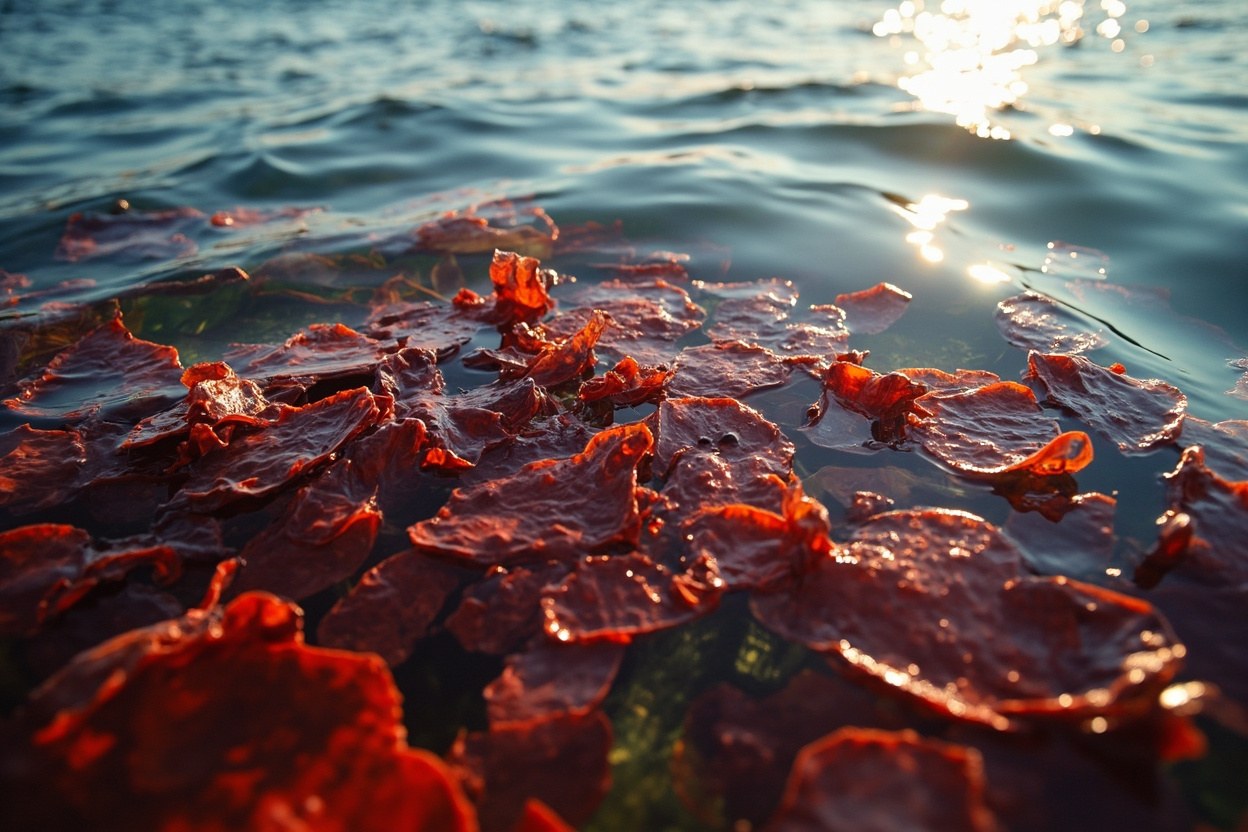
Carrageenan is a family of sulphated polysaccharides extracted from red algae, mostly Kappaphycus alvarezii and Eucheuma denticulatum, which are farmed in tropical waters around Indonesia, the Philippines, Tanzania and parts of the Caribbean. The dried seaweed is washed, cooked in an alkaline solution, filtered, precipitated, dried and milled into a fine powder. On a label it appears as carrageenan, E407, or sometimes Irish moss, the older common name.
Three commercial grades matter for shoppers. Food grade carrageenan (the only one permitted in food in the UK, EU, US, Canada, Australia and most of the GCC) is regulated as a processed additive under GB 2760 in China, under the EU Food Additives Regulation 1333/2008, and under FDA 21 CFR 172.620 in the United States. Degraded carrageenan, sometimes called poligeenan, is a separate substance produced by acid hydrolysis at high temperature and is not approved for food. It is mostly a research and pharmacology topic, not a supermarket one.
Inside the kitchen, carrageenan does a few useful jobs. It thickens and gelling milk based desserts without needing gelatin, which is why it shows up in chilled chocolate milk, cream desserts, flans and some yoghurts. It stabilises salad dressings so the oil does not split. It holds the water in sliced ham, which is the one place a Muslim reader is most likely to care about the sourcing. It also appears in plant milks, particularly almond and oat, where it stops the protein from settling, and in some halal vitamin suspensions and protein powders.
The seaweed origin is the reason most fatwas and certifier pages describe carrageenan as mubah, permissible in principle. Seaweed is not an animal, it is not an intoxicant, and the classical fuqaha did not discuss it because it was not part of their food economy. The hard part, as usual, is what happens between the seaweed and the powder.
Where the halal question actually sits: processing, alcohol, and animal co-ingredients
Three points of concern recur across certifier guidance and scholarly responses, and they are worth going through in order.
1. The alcohol question. Some manufacturers use ethanol or isopropanol to precipitate and wash the carrageenan during purification. Residual solvent levels in food grade material are bounded by regulation, usually well under 1000 mg/kg in the EU under Regulation 231/2012, but ethanol is ethanol, and any Muslim who has read the vanilla extract page or the kombucha page on this site will know the instinctive question. The dominant scholarly view, articulated by the Saudi-backed Habibur Rahman et al. papers and reproduced in MUI Indonesia’s 2024 fatwa library, is that trace ethanol below the sensory threshold and below the regulatory limit does not render an additive haram when the alcohol is not extracted for the purpose of intoxication and is not a khamr-producing substrate. Several certifiers, including JAKIM Malaysia and SANHA South Africa, have published line notes stating that ethanol used as a processing aid below 0.5 percent in the final additive is acceptable. The E407 powder you buy or that sits in a finished product is usually a fraction of a fraction of the total, so the realistic alcohol content in a chocolate milk is essentially zero.
2. The animal co-ingredient question. Carrageenan is rarely the only ingredient in a finished food. The hot spots are dairy desserts (where the milk should be halal certified), sliced meats (where the source of the meat matters more than the carrageenan), and some vitamin or medicine suspensions (where the capsule shell can be bovine or porcine gelatin). On carrageenan itself, there is no standard requirement to use animal derived processing aids, and most plants use alkaline potassium chloride and potassium hydroxide. Some older or small scale producers have been known to use isinglass or bone char filtration in a mixed facility. That is not the norm, but it is the reason a blanket assumption is unsafe.
3. The cross contamination question. Carrageenan plants sometimes run gelatin in the same line. Halal certifiers, particularly JAKIM, MUI and GIMDES, treat shared equipment as a defined risk and require either a documented clean down procedure or a separate line. If the finished product carries a recognised halal symbol, this risk has been audited at the plant level. If the product does not carry a symbol, the risk is unknown.
What major certifiers currently say about E407 in 2026
The short version: every certifier that publishes a public position treats E407 as permissible when the production line is halal controlled, and most do not require an E number to be listed separately on their certificate database. The longer version is worth knowing.
MUI Indonesia. The Lembaga Pengkajian Pangan, Obat-obatan, dan Kosmetika Majelis Ulama Indonesia has, since its 2014 fatwa on food additives and updated in its 2023 list, classified E407 as halal provided it is not processed with haram solvents or animal derivatives. MUI does not list every E number individually, so a brand carrying the MUI logo on a finished product is the practical assurance, not the MUI database entry.
JAKIM Malaysia. The Malaysian Department of Islamic Development maintains a published reference for additives that includes carrageenan, classed as mustaqim (sound) subject to a clean line. Malaysian halal certified finished products list the certificate number and the certificate is searchable on the JAKIM Halal Malaysia Directory.
SANHA South Africa. The South African National Halal Authority certifies many dairy and dessert products that contain E407. SANHA explicitly includes carrageenan in its approved additives appendix, and adds the standard caveat about ethanol residues below the threshold defined by SANHA’s parent body, SANHA International.
IFANCA and HFSAA (North America). The Islamic Food and Nutrition Council of America and the Halal Food Standards Alliance of America both treat E407 as halal for food use. Finished products that bear their crescent and the letter M, or the HFSAA seal, have been audited, including for shared equipment.
ESMA and GIMDES (UAE and Turkey). The Emirates Authority for Standardisation publishes additive rulings, and GIMDES in Turkey has issued a line item on carrageenan classifying it as helal for the Turkish market. UAE-based manufacturers importing carrageenan will typically request a halal letter from the supplier to accompany the shipment.
The pattern is consistent. The additive itself is not the problem. The audit, the line, and the co-ingredients are.
How to read a label, in five quick checks
If you are standing in a shop aisle, the following five questions take about ten seconds and resolve most of the doubt.
1. Is there a recognised halal symbol on the pack? If yes, the work has been done. JAKIM, MUI, IFANCA, HFSAA, SANHA, ESMA, GIMDES, HQC, IHI Alliance, Halal Monitoring Authority and a dozen others operate with overlapping but not identical standards. The 2026 guide on this site walks through which symbols actually help you choose. Symbols to treat with more caution are private brand seals, country-of-origin seals that bundle halal with kosher, and any certificate that cannot be verified online.
2. Is carrageenan the only additive, or is there gelatin nearby? Gelatin is the giveaway that animal protein has been added alongside the seaweed thickener. If the ingredient list shows gelatin (E441) on the same line as carrageenan, the product is almost certainly not vegetarian, and unless the gelatin is explicitly fish or halal bovine, you should look elsewhere. In plant milks, gelatin should not be present at all, so its appearance is a red flag.
3. What kind of product is it? A vegan oat milk is the easiest case, because there are no animal ingredients to worry about at all. A dairy chocolate milk is the second easiest if the dairy is from a halal certified processor (most supermarket own brand UK dairy is halal by default, but it is worth checking for a statement on the pack). A sliced turkey or chicken product is the hardest, because the carrageenan becomes a secondary concern compared with the meat source and the broth used.
4. Is the product from a country with strong default halal assurance? In the UK, most supermarket own label dairy and dessert products are produced at halal audited sites, even when they are not labelled halal, because the lines are shared with halal certified runs. In Saudi Arabia, the UAE, Indonesia and Malaysia, halal certification is a precondition for shelf listing, so non halal certified imported E407 products are rare. In the United States, the default is the opposite: you should expect to read the label.
5. Is the brand responsive? Send a polite email or message. Most brand customer service teams have a halal or vegan inbox and will reply within a couple of working days with the certifier name, certificate number, and the scope of the certification. A non response is information in itself.
Common products that contain E407, and how Muslim shoppers handle them
The table below covers the categories where readers most often email us, with a practical summary rather than a yes or no, because the answer really does depend on the brand and the line.
| Product type | Typical role of E407 | Halal status in practice | What to check |
|---|---|---|---|
| Chocolate milk and flavoured milk | Suspension of cocoa | Usually fine on UK and GCC supermarket own labels | Halal symbol or brand statement; gelatin should not be present |
| Plant milks (oat, almond, soy) | Stabiliser | Generally fine, vegan by default | Check for shared equipment statement if you are anaphylactically cautious about dairy or nut traces |
| Yoghurts and set desserts | Texture and water retention | Brand dependent | Look for the halal symbol on the lid; the dairy base is the bigger question |
| Processed sliced meats | Water binding, slicing aid | Brand and supplier dependent | Confirm the meat source first, the carrageenan second |
| Ice cream and frozen desserts | Prevention of ice crystal growth | Often fine if halal certified | Watch for ethanol in flavour carriers; check the certifier symbol |
| Infant formula | Protein stabilisation | Most major brands carry halal certification on the variant sold in Muslim majority markets | Use the manufacturer’s halal line search |
| Vitamin and supplement suspensions | Thickener in liquid formulations | Brand dependent | Look for halal symbol on the outer carton; check the capsule shell for gelatin |
For a working tool, the halal certification in 2026 post on this site lays out which seals carry weight, and the packed school lunch guide walks through real lunchbox products that contain E407 alongside the rest of the ingredient list.
The short answer on carrageenan for Muslims
E407 is a seaweed extract, not an animal product, and is not intoxicating in any measurable sense. In the language of Islamic food law, the raw material is tayyib and the typical industrial processing is tahir. The remaining work is the same as for every other modern additive: identify the production line, the processing aids, and the co-ingredients, and trust the audit when a recognised certifier has signed off. If no certifier has signed off, the product is not automatically haram, but the level of certainty drops, and that is when the email to the brand earns its keep.
For readers who keep an E numbers list, a one line note is enough. Carrageenan, E407, plant origin, usually fine, but the symbol on the pack is what you are really buying.
Quick answers
- Is E407 carrageenan vegetarian and vegan?
- Yes, in the form used in food. It is extracted from red seaweed using alkaline solutions, and standard food grade E407 does not contain animal derived ingredients. Some processing aids are theoretical possibilities, but in commercial practice the additive is plant based.
- Does carrageenan contain pork?
- No, pork is not an ingredient. The concern is usually shared production lines or co-ingredients such as gelatin, which is a separate E number (E441) and would appear separately on the ingredient list.
- Is carrageenan safe to eat?
- Food safety regulators, including EFSA, the FDA, and FSANZ, currently permit food grade carrageenan within defined limits. Degraded carrageenan (poligeenan) is a different substance that is not approved for food, and the two are not interchangeable.
- What is the difference between E407 and Irish moss?
- Irish moss is the old common name for Chondrus crispus , a red alga that produces carrageenan. Most commercial E407 now comes from Kappaphycus and Eucheuma species farmed in the tropics, but the principle is the same.
- Can I drink a UK supermarket chocolate milk with E407?
- Most UK supermarket own label chocolate milks are produced at sites that also run halal certified lines, and the carrageenan itself is seaweed based. If you want certainty, look for a halal symbol on the pack or contact the retailer’s customer service team.
General information, not a fatwa. Where scholars differ, we try to say so. For your situation, ask a scholar you trust.