In the house
Writing an Islamic will (wasiyyah)
Updated 6 September 2026
Most explanations of a wasiyyah stop at the headline number: you can leave up to a third of your estate to whoever you like. What gets skipped is that this third is a hard ceiling, not a starting point, and the other two thirds were never yours to redirect in the first place. Faraid, the fixed inheritance shares, runs underneath a will whether you write one or not.
The one job a wasiyyah has
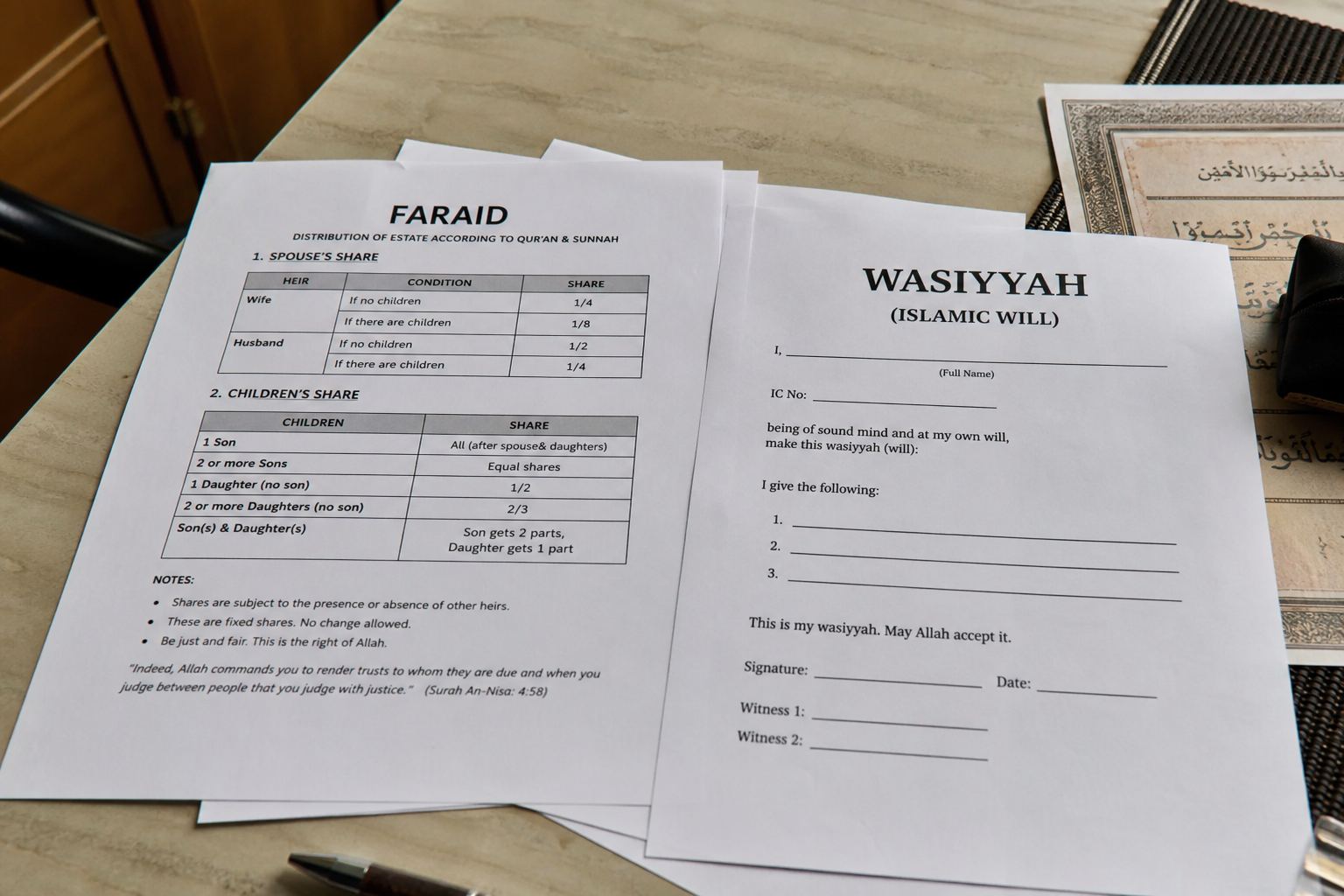
A wasiyyah is a written declaration of how you want part of your estate handled after you die. In Islamic law it has a specific, limited job: it lets you direct up to one third of your net estate, what's left after debts, funeral costs, and any zakat you owed are settled, to people or causes who would not otherwise inherit under faraid. It does not let you rewrite who inherits, change how much they get, or override the fixed shares assigned to spouses, children, and parents.
The one third ceiling
That third can go to a favorite charity, a friend who cared for you, a grandchild who is otherwise excluded because their parent is still living, or a non-Muslim relative who has no claim under faraid at all. It's a genuinely useful tool for exactly those situations, the people and causes faraid structurally leaves out.
Go beyond a third and the excess bequest needs the consent of your other heirs after you die. Without that consent, most scholars hold that only the first third stands and the remainder reverts to the fixed shares.
Why you can't add to an heir's share
There's a well established principle behind this, often summarized as no bequest to an heir. If someone is already entitled to a fixed share under faraid, a wasiyyah generally can't be used to give them more, or less, than that share. The reasoning is simple enough: the Quran already assigned their portion, so a will can't quietly renegotiate it.
Scholars do note one common exception. Other heirs can, after your death, voluntarily agree to let a bequest to one of their own stand. That consent has to come from the heirs themselves; it isn't something you can lock in ahead of time just by writing it into the will.
Faraid still runs underneath it
Whatever isn't covered by a valid wasiyyah, or all of it, if you never write one, follows faraid. Those shares are fixed by relationship: spouse, children, parents, and, depending on who's living, siblings, grandparents, and others further out. The framework comes primarily from Quran 4:11-12 and 4:176, but the actual arithmetic for a specific family gets complicated fast. Two children and a spouse produce one calculation; a childless couple with living parents produces a completely different one. This genuinely isn't something to estimate from a general formula. A qualified scholar, or a dedicated faraid calculator built for your actual family structure, is the reliable way to get a real number.
| Wasiyyah (your will) | Faraid (fixed shares) | |
|---|---|---|
| Portion of estate | Up to one third, net of debts and funeral costs | The remaining two thirds, or the whole estate if there's no wasiyyah |
| Who can receive | Non-heirs: charities, friends, excluded relatives, causes you choose | Fixed heirs only: spouse, children, parents, and others per the family structure |
| How much they get | Whatever you decide, within the one third limit | Set proportions, not adjustable by personal preference |
| If you do nothing | No effect, this portion simply joins the faraid pool | Applies automatically regardless of whether you left instructions |
Why write one when faraid applies either way
If the fixed shares kick in automatically, it's fair to ask why bother. The honest answer is that faraid handles the math, not the mess around it. Families that never had a conversation about a parent's wishes are far more likely to end up in dispute over things that should have been simple: who manages the process, what happens to sentimental items that don't divide neatly, whether debts and outstanding zakat were even accounted for before anyone got paid. A wasiyyah, even a short one, does real work beyond the one third:
- It names who is authorized to handle the estate, rather than leaving that to be sorted out under pressure.
- It records debts and financial obligations, including zakat you owed but hadn't yet paid, so the estate is settled honestly before any distribution happens.
- It puts your wishes for that one third in writing, instead of leaving family members to guess or argue about what you would have wanted.
- It can name guardians for minor children, a decision faraid itself does not make for you.
That second point matters more than people expect. Debts, including unpaid zakat, come out of the estate before faraid divides anything, so an inflated or understated number changes what every heir actually receives. If you're not sure what you currently owe, running it through a zakat calculator, one that handles crypto at today's value and lets you choose the gold or silver nisab standard, is a better starting point than guessing at year's end.
That habit of checking instead of assuming is useful well beyond estate planning. It's the same reason it's worth running a packaged snack through a halal ingredient checker rather than trusting a label at a glance, or looking twice at something like whether creatine is halal, where the real question turns out to be the capsule and flavoring rather than the creatine itself.
If you don't have a wasiyyah yet, start with one page: write down what you want your one third to cover, name who should handle your estate, and tell your family, now, where that page will be when they need it.
Quick answers
- Can I leave everything to charity?
- Not in the classical model if Quranic heirs exist. Talk to a practitioner who does both faraid and local law.
- Is a printout from this site a will?
- No. We do not generate documents.
- Does zakat belong in the will?
- Unpaid zakat is often treated as a debt on the estate. That is a reason to keep the kitchen-table sum current.
General information, not a fatwa. Where scholars differ, we try to say so. For your situation, ask a scholar you trust.