In the house
Islamic inheritance (faraid) basics
Updated 6 September 2026
If you're facing an inheritance that needs dividing, start by listing every relative who survived the person who died, because the shares hinge on that list rather than on any single formula. Many people expect one tidy rule to cover the whole thing, something like "sons get double what daughters get." That rule exists, but it's one piece of a much larger structure, and it only applies in certain situations. The framework assigns fixed shares to specific relatives, and which relatives, and how much, depends entirely on who else is alive when the estate is settled. It's rarely as simple as it looks from the outside.
where these shares actually come from
Faraid is the body of Islamic law that governs how a deceased Muslim's estate gets divided among their heirs. It isn't a set of customs that developed over time the way some inheritance practices did elsewhere. The core shares are stated directly in the Quran, mainly in verses 4:11, 4:12, and 4:176, and then explained and filled out further by hadith and centuries of scholarly consensus. Because so much of it is spelled out explicitly in scripture, this is one of the more precisely defined areas of Islamic law, even though applying it to a real family is anything but simple.
fixed shares, but the list of who qualifies keeps shifting
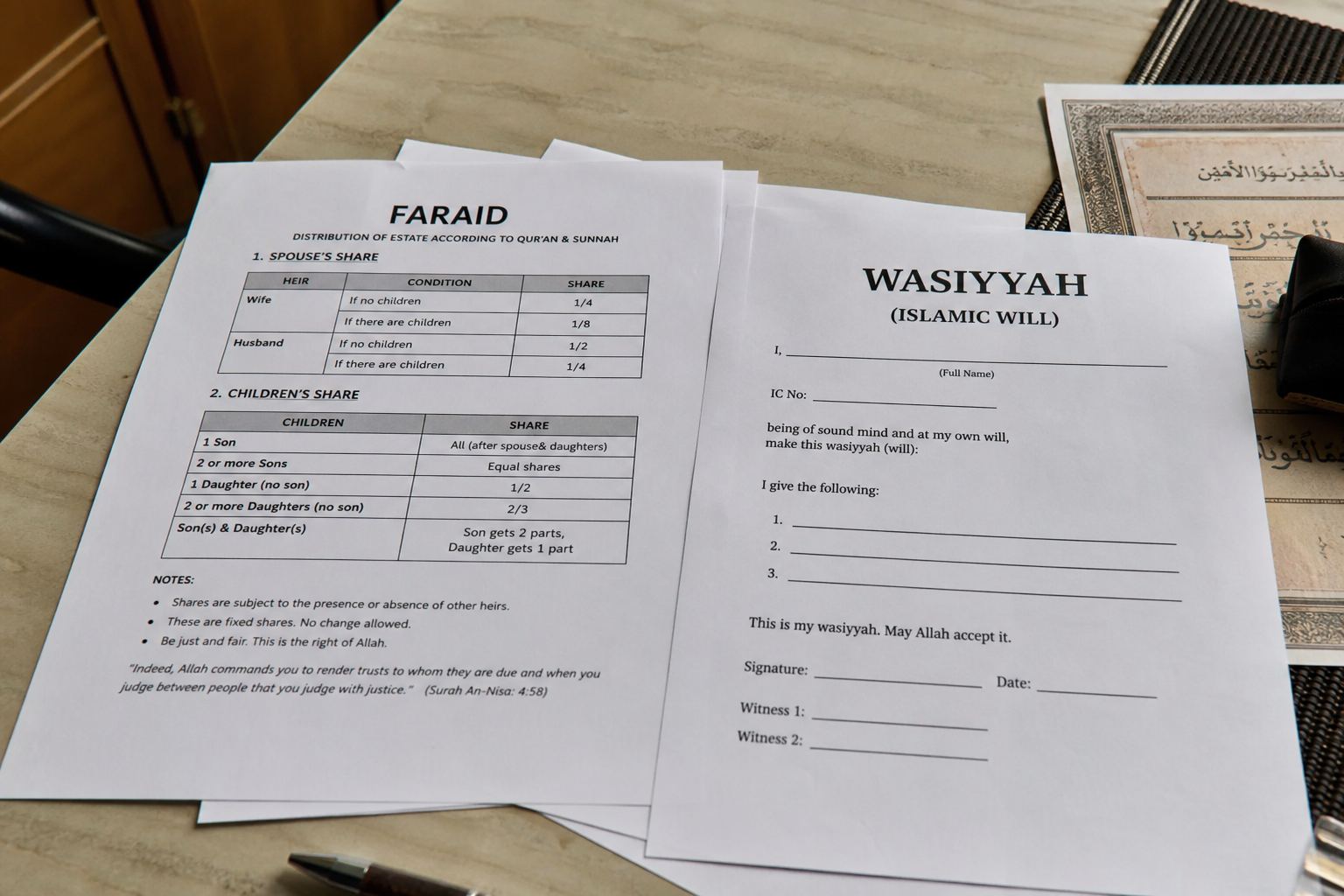
The relatives who receive a guaranteed, predetermined portion are known as ashab al-furud, roughly "the people of fixed shares." Depending on the family, this can include a surviving spouse, children, parents, and in some cases siblings or grandparents. The word "fixed" describes the fraction, not the outcome, because the fraction itself changes based on who else survives. A husband's share looks different if his wife left children behind versus if she didn't. A mother's share shifts if the deceased had siblings, even siblings who don't inherit anything themselves. Add or remove one relative from the picture, and shares that seemed settled can move.
Here's a small, illustrative look at how that works for a few commonly asked-about relatives. This is meant to show the pattern, not to calculate anyone's actual estate.
| Heir | Share can shift between | What typically causes the change |
|---|---|---|
| Husband | 1/4 or 1/2 | Whether the wife left surviving children or grandchildren |
| Wife (or wives, shared) | 1/8 or 1/4 | Whether the husband left surviving children or grandchildren |
| Mother | 1/6 or 1/3 | Presence of children, or two or more siblings of the deceased |
| Daughter (sole child) | 1/2, or a residual split | Whether a son is also present, since sons and daughters together inherit as residual heirs rather than fixed shares |
Even this short list leaves out grandparents, siblings inheriting in their own right, and what happens when a fixed-share heir and a residual heir exist side by side. That's the honest state of it. Faraid is a genuine system with real logic, but the logic only resolves once you know the full family tree, and even scholars trained in it work through each case methodically rather than from memory.
the third you're free to direct yourself
Alongside the fixed shares, a Muslim may leave a wasiyyah, a will, directing up to one third of their estate to people or causes outside the fixed-share system, charities, distant relatives, a friend who cared for them, whatever they choose. The remaining two thirds, or the entire estate if no wasiyyah was made, follows the faraid shares. One principle is well established across the schools of thought here: a wasiyyah generally can't be used to leave money to someone who is already a fixed Quranic heir, since they're already receiving their own defined portion under faraid. The one third is meant to reach beyond that circle, not add to it.
why this page won't hand you a formula
It would be easy to turn the table above into a step-by-step calculator and call it done. That would also be irresponsible. Faraid calculations depend on details that are easy to miss if you're not trained in it: whether a sibling is full, paternal, or maternal changes their standing entirely; whether grandchildren inherit in place of a deceased parent is itself debated; and outstanding debts, funeral costs, and any zakat still owed on the estate's wealth need to be settled before shares are even worked out. If part of that wealth includes assets that move in value, our zakat calculator can help figure out what's actually owed, including on crypto valued at today's price rather than what it cost when it was bought.
That's the reason genuine faraid calculations are usually done by a qualified scholar, an Islamic inheritance specialist, or a dedicated faraid calculator built for the purpose, not estimated from a general explainer. This page exists to give you the shape of the system, not a substitute for that process.
Practical questions about daily living tend to come in clusters once someone starts sorting out an estate or a household's obligations. If you're also weighing what's permissible day to day, we've covered related ground on things like whether creatine supplements are halal and how to run ingredients through our halal ingredient checker when a product label leaves you unsure.
If you're facing an actual estate right now, with real names and real numbers attached to it, please don't rely on this page, or any general page, to work out the shares. Take the specifics to a qualified scholar or a trusted faraid specialist who can sit with your family's exact situation and calculate it properly. That conversation is worth having early, and it's worth having with someone qualified to guide you through it.
Quick answers
- Can I write whoever I want into the will?
- A wasiyyah can cover up to a limited portion in the classical model, and not to a Qur'anic heir in many views. See the will page.
- Does this replace local law?
- No. Many countries require a civil will as well. This is not legal advice.
- Is there a calculator here?
- No. A missing sibling changes the shares. Use a scholar or a qualified practitioner.
General information, not a fatwa. Where scholars differ, we try to say so. For your situation, ask a scholar you trust.