In the Pantry
Is Popping Boba Halal in 2026? A Bubble Tea Label Guide
Updated 20 October 2026
Most popping boba sold in UK bubble tea shops and online is technically vegan on the front, but the alginate shell and the syrup around it are not the only things to check.
Why popping boba is a different question from tapioca pearls
Tapioca pearls, the chewy black balls at the bottom of a milk tea, are usually just cassava starch, sugar and a colour. The halal question on those is mostly about the caramel colour (E150a is fine, E150c and E150d can be made with ammonia processes that some Muslims prefer to avoid) and whether the tea itself is brewed with anything more than water and leaves. Popping boba, the little juice-filled spheres that burst when you bite them, are built differently and so is the label.
A popping boba sphere has three jobs to do at once. It has to hold a liquid filling without leaking. It has to survive sitting in a sugar syrup on a shop counter for hours. It has to burst in the mouth at a predictable moment. The way manufacturers achieve that is by dripping a flavoured liquid into a calcium bath, which forms a calcium alginate skin, or by extruding a starch blend through a nozzle and pumping the filling in afterwards. Either way, you are looking at a multi-ingredient product, not a single-ingredient one, and that is where the variables come in.
Three layers matter. The shell, which is usually sodium alginate (E401) from brown seaweed, or a mix of starches. The filling, which is fruit juice, flavouring, sugar and, in some brands, a thickener to keep it from leaking out. And the surrounding syrup, which is where shelf life and mouthfeel come from. Each layer has its own ingredient declaration, and any one of them can take the product out of halal territory.
So the short version: with tapioca pearls you mostly worry about E150. With popping boba you have to read the whole back-of-pack panel, because the filling is often the part that is left vague.
The five ingredients that decide a popping boba label in 2026
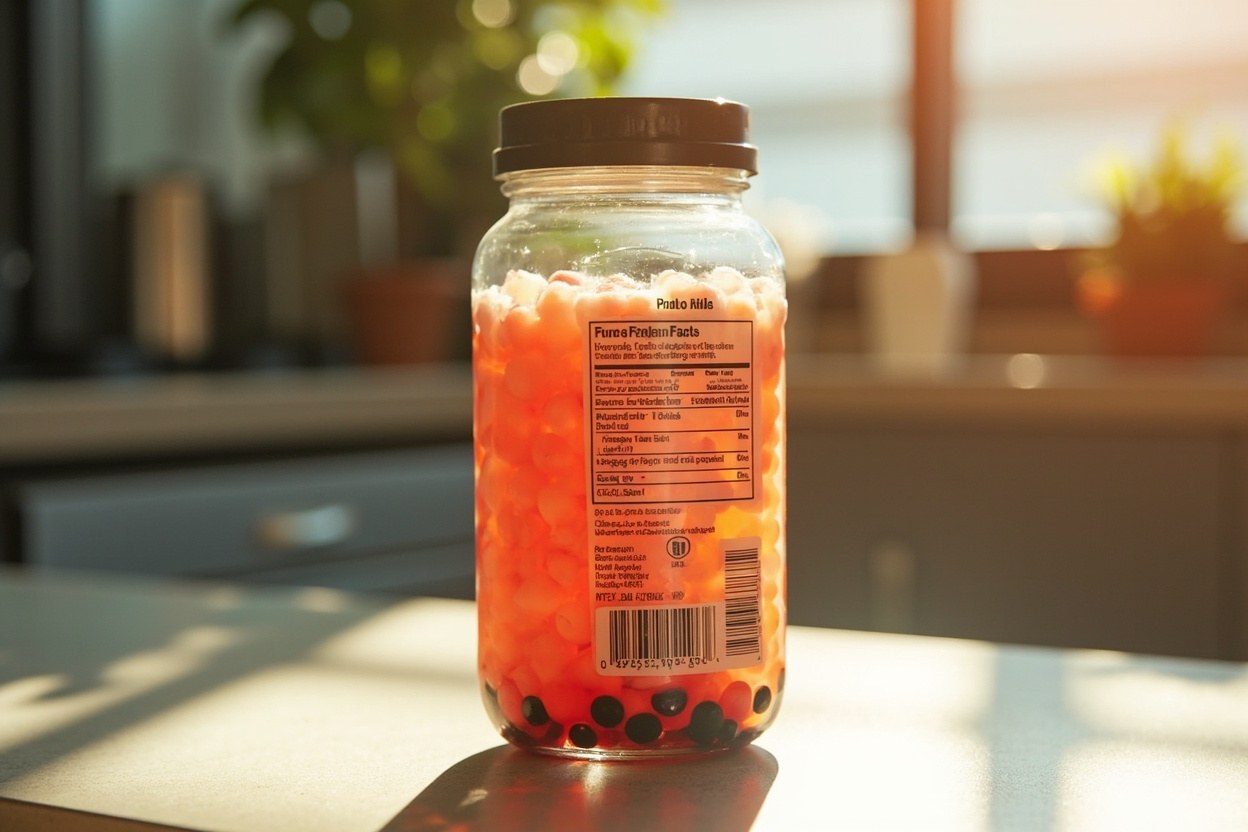
When you turn a popping boba jar around, you will usually see a fairly short list, but every line on it can swing the verdict. These are the five to slow down for.
1. The shell: sodium alginate or starch? Sodium alginate (E401) is extracted from brown seaweed and is generally considered halal. The starch alternatives are usually tapioca or modified corn starch (E1442, E1420 are common). Modified starches are plant-based, so they are normally fine, but if the modification process uses porcine-derived enzymes a halal status would not be claimed. In 2026, a UK supermarket own-label popping boba will typically just say "sodium alginate" or "modified starch" without going further, which is one of the reasons a halal-certified jar is the easy option.
2. The filling: is gelatine hiding in there? This is the big one. Some cheaper popping boba use bovine or porcine gelatine in the filling to give it that slightly gummy texture. Beef gelatine from a non-stunned source is the usual sticking point for halal shoppers, and porcine gelatine is the outright non-starter. On a UK label, gelatine will simply be declared as "gelatine" without species. If the jar is halal-certified by a body like Halal Monitoring Committee (HMC), Halal Food Authority (HFA) or European Halal Certification, the gelatine question has been answered for you and the species is documented. If the jar carries no symbol, you cannot tell from the front whether the gelatine is beef, pork, or fish, and that is the risk.
3. The flavouring: natural, artificial, or alcohol-carried? Fruit flavourings are usually fine. The question is the carrier solvent. Many natural strawberry, lychee and mango flavourings are dissolved in ethanol or propylene glycol to make them pourable. A 2026 ingredient panel will not declare the carrier separately, so you have to rely on either the halal symbol or a manufacturer statement. Most reputable bubble tea suppliers in the UK and EU have moved to water or propylene glycol carriers in the last two years because their Muslim customer base asked, but the small Asian import brands on marketplaces sometimes have not.
4. The colour: which E number, and which E number group? Fruit juices give the colour in the better jars, and the panel will just say "fruit and vegetable concentrate" or "carrot and hibiscus extract". Cheaper jars use E numbers: E163 (anthocyanins, plant-based, fine), E160a (beta-carotene, fine), E133 (brilliant blue, synthetic but halal), E129 (allura red, synthetic but halal). None of the common boba colours are animal-derived in commercial use, so the colour line is rarely the deciding factor, but it is the line that is most often left vague on white-label products.
5. The preservative and acidity regulator: E202, E330, E331. Potassium sorbate (E202) is the usual preservative, and it is a synthetic salt, halal. Citric acid (E330) is fermented from sugar, usually halal. Sodium citrate (E331) is a buffer, also fine. None of these are the line that breaks a verdict, but if you see E1105 (lysozyme) listed anywhere on the panel, that is a protein from egg white and would need a halal assessment, although it is rare outside of cheese.
How to read a 2026 popping boba label in three minutes
You do not need a chemistry degree. You need a habit.
Step one, look at the back panel, not the front. The front of a popping boba jar almost always says "fruit juice filling" and shows a strawberry. The back is where the species, the alcohol and the gelatine question is answered or left open.
Step two, look for a halal symbol. In the UK in 2026, the symbols that mean a real, audited scheme are HMC (Halal Monitoring Committee), HFA (Halal Food Authority), and the smaller but credible European Halal Certification mark. The dot-H, the inverted triangle, and various other shapes do not necessarily mean anything unless the body behind them is named on the pack. If the pack says "halal friendly" or "suitable for halal diets" in text but carries no symbol, that is a marketing line, not a certification.
Step three, if there is no symbol, read the five lines above in order. Shell, filling, flavouring, colour, preservative. If the word "gelatine" appears anywhere, the jar is not halal unless the species is named as fish or as halal-slaughtered beef, which on a UK consumer jar it almost never will be. If the word "ethanol" or "alcohol" appears, treat it as not halal until the manufacturer confirms the level is below 0.5 percent and is not from a grape or date source. If none of those words appear and the E numbers are in the list above, the jar is, in practical terms, fine for most Muslim households.
Step four, check the cross-contact line. Some UK jars now carry a "may contain" or "produced in a facility that also handles" statement. For a product that is genuinely free of animal-derived ingredients, this is rare. For a product that contains gelatine and is then re-packed, it is common. Treat "produced in a facility that handles pork" as informative rather than decisive, but it does affect the verdict for stricter households.
A 2026 comparison: five common popping boba brands available in the UK
The list below is a snapshot of what was on UK shelves in October 2026, based on the major bubble tea suppliers and supermarket own labels. It is meant to show the spread of what is available, not to crown a winner. Prices are typical online retail at the time of writing.
Brand one: Yuki Bursting Boba (Strawberry, 1.2kg catering jar). Carries HMC certification. Shell is sodium alginate, filling is fruit juice concentrate and sugar, no gelatine declared, no alcohol. E number colour from E163 and E160a. This is the easy answer for a home Muslim household and for a bubble tea shop that wants a single stock line.
Brand two: Tea Zone Bursting Boba (Lychee, 3.4kg catering bag). No halal symbol on the catering bag. The UK distributor confirmed by email in 2026 that the product is made to a vegan recipe and does not contain gelatine, but the catering bag does not carry a mark and the small retail jars do. Worth buying from a supplier who can pass on the manufacturer letter.
Brand three: IPA (International Popping Aid) Strawberry Balls, 3.5kg catering pouch. Carries European Halal Certification. Shell is starch-based, filling uses a fruit preparation, no alcohol declared. Widely used in UK high street bubble tea chains as of 2026.
Brand four: Wu Fu Yuan Popping Boba (Passion Fruit, 2.5kg jar). Imported via Amazon UK. The English back panel simply says "gelatine" with no species. The Chinese-language back panel is more detailed. In 2026 this product is not halal-suitable on the information available to the buyer. The same brand sells a non-gelatine range under a different SKU, which is.
Brand five: Holland and Barrett Popping Boba (Mixed Fruit, 240g retail jar). Vegan Society logo. No gelatine, no alcohol, E numbers limited to E330 and E202. Suitable for halal diets in practical terms, although it is not halal-certified because the certification schemes do not cover vegan-labelled food without an audit.
The pattern across the five is that the brands that bother to put a halal symbol on the pack are also the brands that have already answered the gelatine, alcohol and cross-contact questions. The brands that do not bother are asking the buyer to do the work.
What about the bubble tea shop itself?
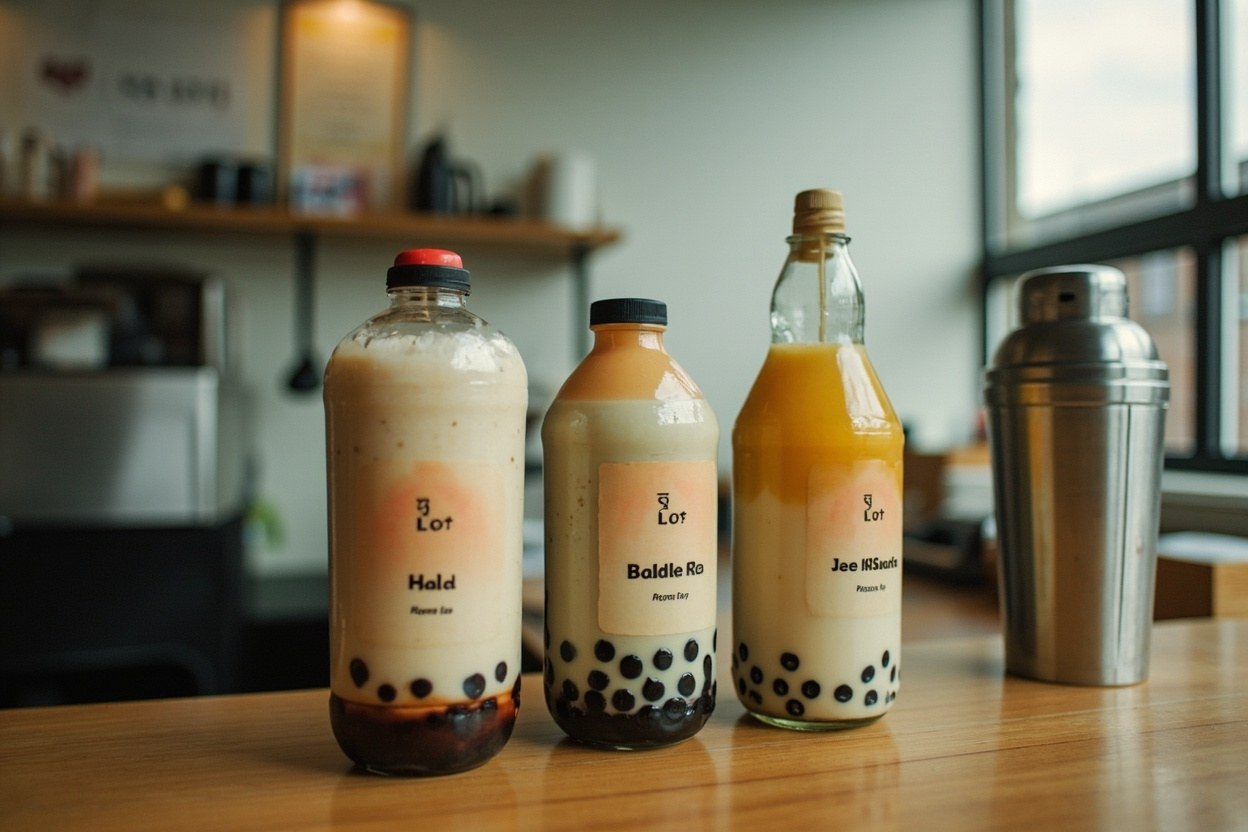
You can buy a halal-certified jar of popping boba and still be served a drink that is not halal-suitable, because the syrup in the cup, the tea base, and the milk or creamer are separate products. A Muslim household reading labels at home is one thing. A Muslim customer standing at a counter in a shopping centre is another.
Three things to ask, or to look for on a wall certificate, in 2026. Ask which halal body the shop uses. HMC and HFA both publish an up-to-date register of certified premises, so a shop name can be checked on a phone in under a minute. Ask whether the milk is halal. The black pearl and the popping boba might be certified, but if the creamer is a standard dairy creamer with E471 derived from animal fat, that is a separate question. And ask whether the tea itself is flavoured with anything alcoholic. Yuzu, lychee and certain jasmine flavourings sometimes are.
On the IslamHood business verification side, the question of whether a bubble tea shop is halal-suitable is a question about documentation, not about vibes, and a 2026 high street chain will usually have a folder of certificates the manager can show you. Smaller independents may not, in which case the popping boba label on the back counter is the easiest clue: if the jar behind the bar is an HMC- or HFA-certified one, the shop has already done the audit on the ingredient you cannot see.
FAQ: the questions a Muslim shopper actually asks about popping boba
A short checklist before you buy or order
Before you commit to a jar, a pouch or a cup, run through this. The list is short on purpose, because the point is to make the decision a habit, not a research project.
One, is there a halal symbol from a named UK or EU body. If yes, you are done. Two, is the word gelatine anywhere on the panel. If yes, and no species is named, the jar is not halal-suitable. Three, is the word ethanol or alcohol anywhere on the panel. If yes, treat as not halal until the manufacturer clarifies. Four, is the colour from a named fruit or vegetable source, or from an E number in the safe list. Either is fine. Five, does the surrounding syrup use any of the ambiguous E numbers (E471, E472, E473) without a plant source declared. If yes, ask. Six, if you are buying a catering pouch, ask the supplier for the manufacturer letter and keep a copy.
Popping boba in 2026 is one of those products where a Muslim shopper can make a clean decision in three minutes, but only if the pack gives the information, and only if the shopper knows which five lines to read. With the five lines above and a halal symbol where one is on offer, the answer is usually yes, and the cup is yours.
Quick answers
- Is popping boba always halal?
- No. Some popping boba use gelatine of undeclared species in the filling, and some flavourings are carried in ethanol. A 2026 jar with a halal symbol from HMC, HFA or European Halal Certification has been audited, but an unlabelled jar has not.
- Can popping boba be vegan and still not halal?
- It is rare, but yes. A vegan label rules out animal-derived ingredients, but it does not address alcohol carriers in the flavouring or ambiguous E numbers, and it is not the same as a halal audit.
- Does the alginate shell cause any halal concerns?
- Sodium alginate (E401) is extracted from brown seaweed and is generally considered halal. The modification process is enzymatic and does not involve animal-derived material in commercial production.
- What about the tapioca pearls in the same drink?
- Tapioca pearls are usually cassava starch, sugar and a colour, and the colour is the line to check. E150a is fine, while E150c and E150d can involve ammonia processes that some Muslims prefer to avoid.
- Is the bubble tea syrup usually halal?
- Not always. The syrup around the pearls or boba is a separate ingredient declaration and may include honey (which some rulings do not allow in commercial drinks), E471 from animal fat, or alcohol-based flavourings. Treat the syrup as a separate product to the boba.
General information, not a fatwa. Where scholars differ, we try to say so. For your situation, ask a scholar you trust.